
On 7 April 2026, World Health Day served as the backdrop for an unprecedented challenge: making the private sector a full-fledged player in international health diplomacy. This is the ambition of the One Health Economic Forum (OHEF), organised by the French Healthcare Association at the heart of the One Health Summit — the ninth One Planet Summit, initiated by Emmanuel Macron and this time entirely devoted to global health issues.
A One Health summit to meet the challenges of the century
Humans, animals, and ecosystems are inseparable; their health forms a single whole. This principle, known as One Health, lies at the heart of the summit. Yet beyond the philosophy, there is urgency. Pathogens cross species barriers, antibiotic resistance is rising, food systems are under strain, and pollution is accumulating. These dynamics are no longer hypothetical scenarios; they already shape the daily reality of health systems across every continent.
In this context, French Healthcare Association was tasked with organizing the the One Health Economic Forum : the official economic segment of the summit, with support from the Ministry for Europe and Foreign Affairs, creating a space where companies could engage directly with decision-makers, including heads of government delegations and representatives of major international organizations.
Nearly 500 participants, formally invited by the Élysée, responded to French Healthcare Association’s call to place the private sector at the center of One Health diplomacy. For French Healthcare Association, this was a concrete demonstration of its long-held belief that health sovereignty depends on a strong industrial base and durable international partnerships. The goal of this broad collective effort was to foster operational partnerships that deliver tangible results.
To meet the challenges of this century, the summit went beyond intentions. Several concrete announcements highlighted an ongoing momentum, showing how economic actors are turning the One Health approach into operational action.
Servier highlighted a major program to improve access to care for children with cancer in low- and middle-income countries, in partnership with the ACT for Children Foundation. Beyond funding, the initiative strengthens health systems on the ground, developing clinical capacities, supporting healthcare professionals, and structuring comprehensive care pathways. It’s a hands-on approach aimed at addressing a critical issue of health equity.
At L’Oréal, the focus is on prevention and knowledge through the L’Oréal Act for Dermatology program, developed with the WHO Foundation and the ILDS. The program is anchored by several key tools: a global observatory on access to dermatological care, an open image database for practitioners, and an expert group examining links between climate change and skin health. The group also aims to reinforce public-private partnerships and support the development of preventive health policies, particularly in the field of longevity.
Another essential lever of the One Health approach is diagnostics. Through the Mérieux Group, bioMérieux presented the Global One Health Diagnostics Access Compact, a public-private partnership bringing together more than twenty organizations. Its goal is to expand access to essential diagnostic tests across human, animal, and environmental health. Underlying this initiative is a shared conviction among participants: without early detection and strengthened surveillance, no prevention strategy can truly succeed.
One day, three pillars, forty companies
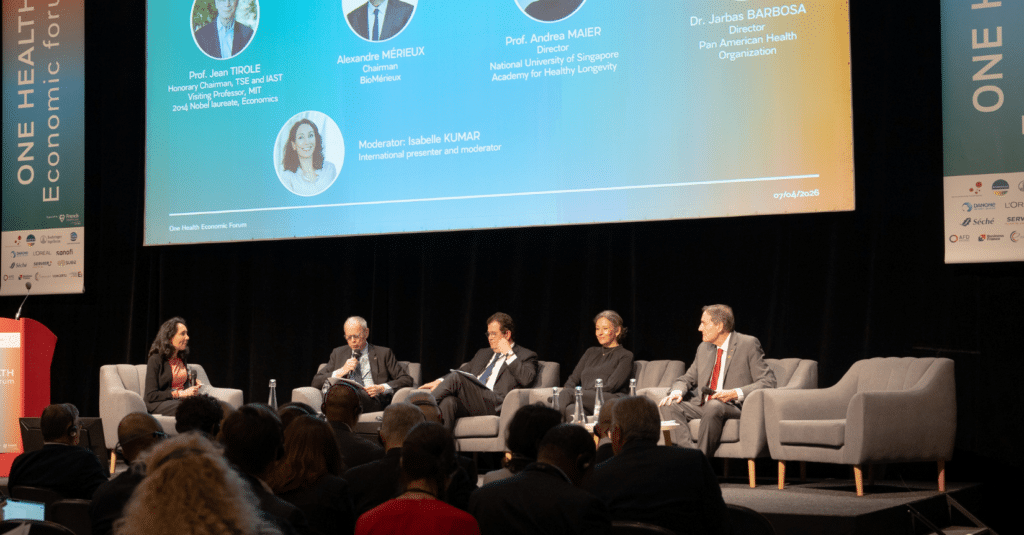
The programme for the One Health Economic Forum on 7 April centred on a high-level session that lasted the entire morning. This series of talks featured an opening address by Ms Éléonore Caroit, French Minister for Francophonie, International Partnerships and French Nationals Abroad, who took the opportunity to commend the French Healthcare Association’s work in promoting a unified ecosystem, which is more committed than ever to advancing the causes of prevention and cooperation for the benefit of everyone’s health.
The discussions, organised into three panels moderated by international journalist Isabelle Kumar, provided an opportunity to address the key priorities of the One Health approach, ranging from prevention to the transformation of health systems.
- The first panel highlighted the need to rethink healthcare pathways in their entirety, incorporating prevention, access to care, nutrition and the fight against inequality. There was a consensus on the importance of adapting these approaches to local circumstances to ensure their effectiveness.
- The second panel focused on the challenges of preparedness and public health sovereignty, highlighting the key role of integrated surveillance, vaccination and environmental infrastructure. The speakers emphasised the need to strengthen public-private partnerships in order to tackle increasingly global health threats.
- Finally, the third panel explored the still under-exploited potential of health data. From its generation through diagnosis to its strategic use, the discussions highlighted its central role in improving the efficiency of healthcare systems, strengthening prevention and supporting major demographic shifts.
Find here the comprehensive programme:

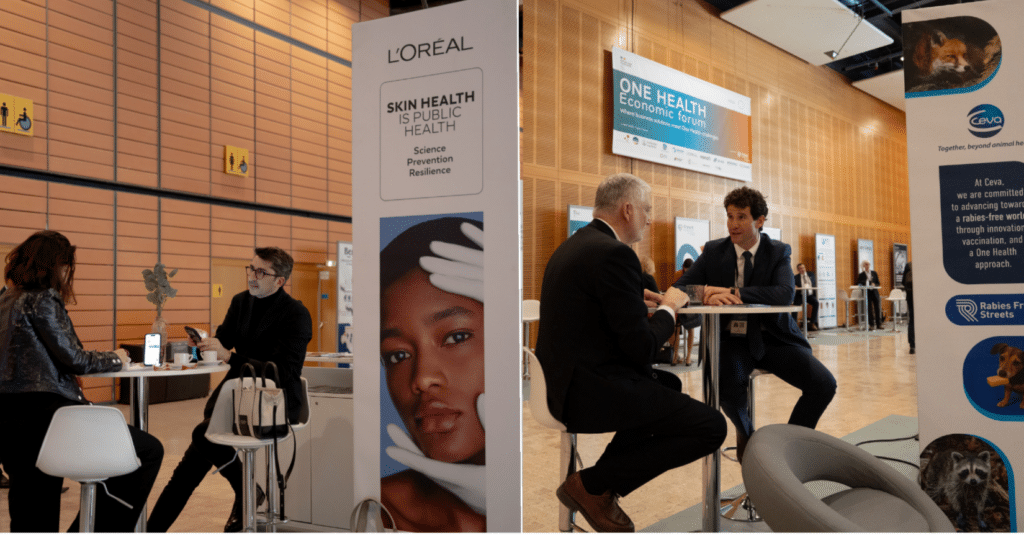
The afternoon saw the shift from discussions to practical interactions. In an exhibition area hosting around forty companies, participants were able to explore practical solutions and engage in focused discussions with project leaders.
Organised via a dedicated platform, the B2B and B2G meetings brought together nearly 500 participants from 35 countries, resulting in over 200 business meetings with exhibiting companies. It was a packed programme focused on identifying partners, exploring opportunities and initiating international collaborations.
This momentum continued right through to the summit’s closing plenary session, attended by heads of state and government and broadcast live during the economic forum, as if to ensure that these discussions were directly aligned with the priorities set at the highest political level.
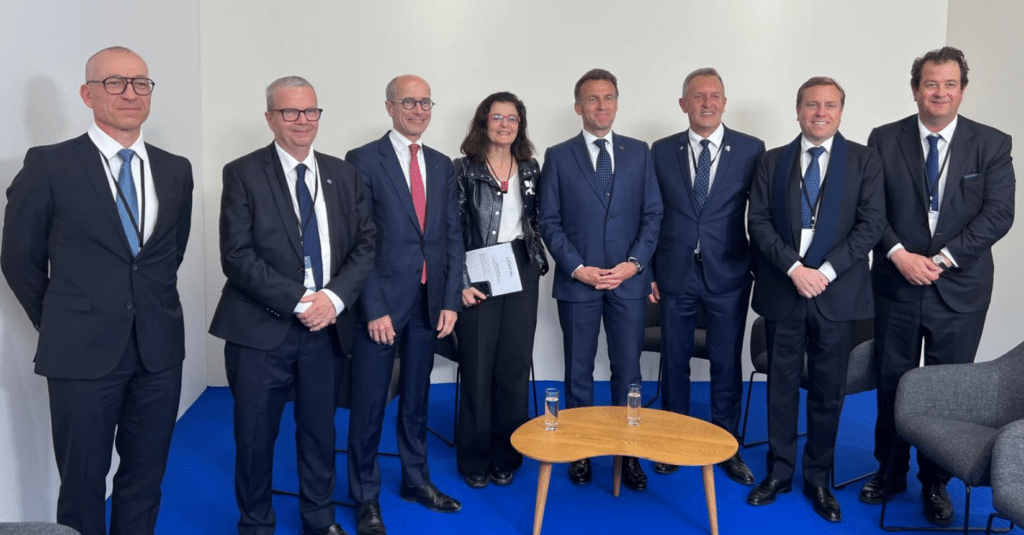
In this context, the forum also hosted a meeting with the President of the Republic, Emmanuel Macron, bringing together the French Healthcare Association and its president, Jean-Pierre Boffy, as well as the CEOs of leading companies working on the One Health initiative. A dialogue at the highest level to embody the ambitions of French Healthcare: to bridge the gap between French diplomacy and its international champions, and to promote sector-specific healthcare expertise abroad for the benefit of global health.
One Health Economic Forum: a political as well as an economic signal
Around forty companies had been selected to take part:
AIA Life Designers, Archimed, Aspida, BCV Care, Beam Alliance, Benta Lyon, BioVersys, BNP Paribas, FPT France, Ginger International, Groupe Carso Holding, HYPharm GmbH, IMeBIO, Infex Therapeutics Ltd, Innovative Diagnostics, LyonBiopôle, MSD Santé Animale, Novair, Praesens Care, Promedeo, Séché Environnement, Tesalys, Airinspace, Biocodex, Invivox, Rofim, SC Johnson, Viatris, AFNOR, IFPMA, CHDS, GARDP, Joing Disabled Unity Awaz Center, Kamana Health Nepal, Université de Yaoundé, ADIT, Environment Nepal, Évolution Digitale Alif, et Mage-X Medical AI.
Among them, proud supporters of this event have joined forces with French Healthcare to become more actively involved in promoting practical One Health solutions: Bavarian Nordic, BioMérieux, Boehringer Ingelheim, CEVA Healthcare, Danone, L’Oréal, Sanofi, Séché, Servier et Suez. These organisations cover the three pillars of the One Health approach: human health, animal health and the environment. The criteria selected by the organisers prioritised international presence, proven expertise in at least one of these pillars, and the ability to make concrete commitments.
By placing the private sector at the heart of an initiative endorsed by the French presidency, France has sent a signal that extends far beyond the scope of the event. Companies operating in the fields of diagnostics, epidemiological surveillance, animal health, the agri-food sector and medical waste management are no longer confined to the role of service providers: they are being invited to shape the global health agenda.
DOWNLOAD THE ONE HEALTH ECONOMIC FORUM PRESS RELEASE: