
Chronic Diseases
A global look at how France delivers prevention, integrated pathways and innovation at scale
Chronic diseases in France are a growing challenge for health systems, requiring prevention, long‑term follow‑up and coordinated care pathways. Chronic diseases are placing sustained pressure on health systems worldwide—making prevention, long‑term follow‑up and coordinated care pathways mission‑critical.
From an international perspective, France stands out for combining system‑level organization and high‑performing hospitals. At the same time, it is accelerating innovation in AI, advanced therapies and industrial scale‑up. This creates concrete opportunities for cooperation with public authorities, health agencies, hospitals, insurers, investors and industry partners.
Key figure — Scale of chronic care
In 2022, 13.4 million people in France were covered under the Long‑Term Conditions scheme (ALD)—around 19% of the population—highlighting the scale of chronic disease management in a universal healthcare setting.
Chronic diseases in France: a system-level response
France promotes a care pathway model that connects prevention, ambulatory care, hospital care and medico‑social support—moving beyond fragmented, sector‑based delivery.
To support quality improvement and accountability, France develops chronic care pathway quality indicators emphasizing coordination, continuity and patient involvement—tools designed for healthcare providers and regulators.
What this enables in practice:
- Prevention and early detection embedded into pathways
- Coordinated care across primary care, hospitals and community services
- Structured long‑term follow‑up, including digital tools and telehealth where relevant
Prevention at population scale
France is strengthening prevention through national initiatives such as “Mon bilan prévention”, offering prevention check‑ups at key ages and supporting earlier risk identification and long‑term health planning.
Oncology (Cancer): a major chronic disease priority in France
Cancer is a central pillar of France’s chronic disease response, combining national strategy, internationally visible clinical excellence and strong research and innovation capacity.
A decade‑long national strategy (2021–2030)
France’s ten‑year cancer strategy (2021–2030) is structured around prevention, quality of life, tackling poor‑prognosis cancers and ensuring progress benefits all populations.
Updated official context: official sources estimate around 433,000 new cancer cases in 2023 in France.
International proof points: high‑performing hospitals and centers of excellence
France’s oncology excellence is anchored in institutions that are visible in international benchmarks such as Newsweek’s World’s Best Specialized Hospitals ranking.
- Gustave Roussy is ranked among the world’s leading oncology hospitals (Newsweek/Statista).
- Institut Curie is also ranked among the world’s leading oncology hospitals (Newsweek/Statista).
A nationwide specialized cancer network
France relies on a dedicated nationwide network of 18 specialized cancer centers (non‑profit institutions fully dedicated to cancer care), coordinated to support multidisciplinary pathways, clinical research and access to innovation across the territory.
The main actors behind France’s cancer ecosystem (who does what)
From an international perspective, France’s cancer ecosystem stands out for national coordination, specialized care delivery and research integration.
National cancer governance and strategy
France’s national cancer institute coordinates cancer control actions, provides scientific and health expertise, and oversees the implementation of the country’s decade‑long cancer strategy.
A nationwide specialized cancer hospital network
A dedicated non‑profit network of 18 specialized cancer centers coordinates multidisciplinary care pathways, clinical research and access to innovation across the territory, and serving as a key entry point for international clinical and research collaboration.
National research coordination
France also operates a national cancer research coordination framework that federates oncology research teams—from fundamental science to translational and clinical research—strengthening performance, knowledge transfer and international collaboration.
Innovation that matters: precision medicine, immunotherapy and AI
Immunotherapy has transformed cancer treatment for several tumor types and continues to expand through clinical research and innovation, alongside precision oncology approaches that integrate molecular profiling and digital capabilities.
Artificial intelligence in oncology
France’s national strategy for AI and health data supports trustworthy adoption, evaluation and scalable deployment. In oncology, this enables AI‑assisted diagnosis, decision support and pathway optimization—particularly relevant to high‑volume hospital settings.
Advanced therapies and industrial scale‑up (biotherapies, antibodies, bioproduction)
Many chronic conditions increasingly rely on advanced therapies—especially biotherapies and therapeutic antibodies—making industrial capacity and scale‑up strategic.
MabDesign (biotherapy and therapeutic antibody ecosystem)
MabDesign supports the structuring and development of the French biotherapy sector, with a focus on immunotherapy and therapeutic antibodies.
France 2030: scaling biotherapies and bioproduction
France 2030’s acceleration strategy on biotherapies and bioproduction reports large‑scale mobilization (19 actions, 250+ partners and €338M public investment after two years), illustrating industrial momentum behind advanced chronic disease treatments.
Beyond oncology: diabetes, cardiometabolic diseases and long‑term monitoring
While oncology is a major pillar, diabetes and cardiometabolic diseases are a growing priority for prevention, long‑term follow‑up and pathway efficiency.
Diabetes & cardiometabolic diseases: scale and excellence
In 2023, more than 3.8 million people were treated with medication for diabetes in France (around 5.6% of the population).
International hospital recognition
AP‑HP Pitié‑Salpêtrière (Paris) appears in Newsweek/Statista’s global ranking for Endocrinology—relevant to diabetes and cardiometabolic care pathways.
Translational ecosystem: IHU ICAN
France hosts dedicated translational structures such as IHU ICAN, embedded in a major academic hospital environment and focused on cardiometabolic diseases (diabetes, obesity and metabolic liver disease), bridging research platforms, data sciences and clinical pathways.
AI and health data: enabling scalable chronic care pathways
In addition, France has published a national strategy for AI and health data (2025–2028) aimed at governance, evaluation and trusted deployment—particularly relevant for chronic disease monitoring and pathway efficiency over time.
What international partners can expect
International partners typically engage with France to benchmark care pathways, access specialized hospital networks, pilot innovation, or scale advanced therapies.
French Healthcare helps international partners connect with the right stakeholders to explore:
- care pathway design and system‑level cooperation (policy dialogue, benchmarking, implementation support)
- hospital partnerships and clinical collaboration, including access to specialized networks
- innovation pilots (AI‑enabled monitoring, pathway optimization) with evaluation focus
- advanced therapies and industrial partnerships (biotherapies, antibodies, bioproduction scale‑up)
Explore further
Primary: Talk to French Healthcare (link)
Secondary: Find treatment options in France (link)
The oncology sector in figures
-
14
CLCC researchers among the 24 French researchers in oncology.
-
350
research facilities run by INSERM.
-
18
Cancer Centers (CLCC) composing Unicancer
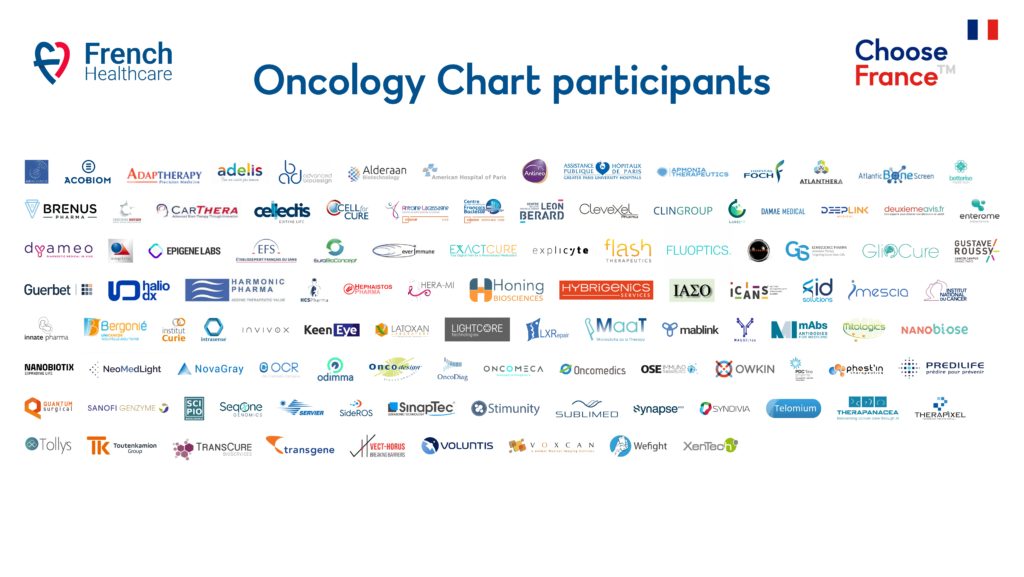
Mapping of French expertise and know-how
The French Healthcare Association and Business France present the first edition of the map of exportable French solutions in the field of oncology. Innovation and excellence in prevention, screening, care and follow-up for cancer patients have finally been brought together in a single document.

French Healthcare Business Forum 2026, recognition for the showcase of French excellence in healthcare

French Healthcare Business Forum: a look back at conferences, workshops and international side events advancing tomorrow’s healthcare systems
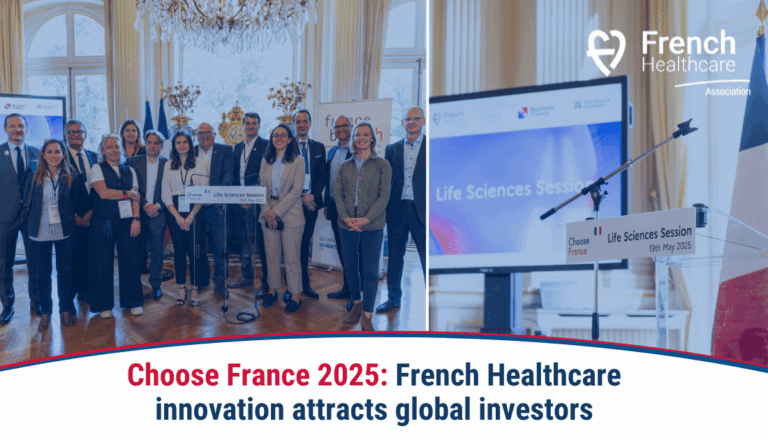
Choose France 2025: French Healthcare innovation attracts global investors